When you’re just starting out, it can essentially feel like you’re staring up at a mountain that seems impossible to tackle. A lot of people start with the PMI Certification and their basically first step is usually to take a CAPM Practice Test. Basically, this article won’t quite just tell you to study harder and hope for the best. As widely acknowledged by experts in the field, we’re going to give essentially you a clear, of course, honest game plan to follow. Notably, we’ll take a look at what all the fuss is about with certifications. What the actual exam experience is like and most importantly show you how to use practice tests to go from feeling totally anxious to literally actually being ready. In short, think of this as a straightforward path to follow from prep to sitting with your head held high after getting that certification.
The Growing Importance of PMI Certification in Today’s Job Market
- The bottom line is that in the project management world, having a PMI certification is no longer just a nice to have on your resume, it’s essential. These days, employers see it as a globally accepted standard that not only shows you understand the language of project management but that you’re also able to put a well-established approach into practice and are genuinely passionate about your work as a project manager.
Why Bosses Are Set on Hiring PMI-Certified Candidates
- It gives them a serious leg up on hiring risk. And let’s be honest, hiring is always a bit of a gamble. But having a PMI certification on that CV makes it clear the candidate has already cleared a pretty high bar & sat through a tough, standardised exam – That takes a lot of the uncertainty out of whether they’ve got the fundamentals down to a decent level.
- A PMI Certification Creates a Common Language. When companies have teams all over the world, they need a standard way of doing things and that’s where PMI’s standards come in (think PMBOK Guide). With a certified professional on board, they can hit the ground running and get up to speed that much faster.
- A PMI-Certified Candidate is a Verified Benchmark. When you’re looking at a bunch of CVs, a certification is a quick way to weed out the non-starters. It’s proof that the candidate has invested in themselves and that’s often a good indicator that they’ll invest in your projects too.
Entry-Level Opportunities With CAPM Certification
Not everyone is PMP ready, thats what the CAPM is for , the entry point.
- Its specifically designed for those with limited project know-how but a whole lot of drive , the ideal setup
- Proves you get the basics of project management – terminology, processes etc thats the kind of knowledge you need to get started.
- Having the CAPM on your cv shows you’ve got the initiative and sets you apart from the rest when applying for coordinator or junior project manager roles – you stand out from the crowd.
Global Acceptance of PMI Exams
Not a local thing, NYC Berlin or Singapore, a PMI cert is still a big deal. PMI is the biggest professional association for project management globally & their exams are widely recognized. As a result, you get the freedom to work anywhere & have options that others might not have.
CAPM Certification: The First Step Toward a PMI Career Path
Think of the CAPM as the foundations of project management that gets you up and running with all the basics you need before moving on to the more advanced Project Management Institute (PMI) certifications like the PMP where you’ll get a chance to pick up the skills & concepts that most of the other certifications are built on.
What CAPM Certification Actually Represents
The CAPM proves you’ve got a solid handle on the project management basics & terminology from ‘A Guide to the Project Management Body of Knowledge’. It’s not about having a decade of real world experience. tIs about showing you really get the concept, the basics. Passing this exam is like saying you’ve got the basics of project management sorted out, you’ve figured out what’s what.
Who Should Choose CAPM Over Other PMI Certifications
- Young graduates with a degree but not much hands-on project experience to speak of.
- People looking to make a career switch into project management from a completely different field.
- Team members who already support projects but are looking to really get a handle on the skills that matter.
- Anyone looking for a PMI certification but just can’t meet the demanding experience requirements that come with the PMP.
Long-Term Career Benefits After Passing CAPM
Getting your CAPM does two big things. First, it immediately makes you more marketable for entry-level positions. Second, and maybe more importantly, it starts the clock. The CAPM is valid for five years, and during that time, you’re gaining the project experience you need to eventually qualify for the PMP. It’s a strategic first step on a longer journey.
Understanding PMI Exam Expectations Before You Prepare
You wouldn’t start training for a marathon without scouting out the course. And same deal if you’re gonna study for your PMI certification and ace the exam then you probably ought to know how the questions get cobbled together.
How PMI Designs Exam Questions
The questions are designed to put your knowledge of concepts to the test in a real world context not just repeat stuff back from the guide.
Knowledge-Based vs Situational Questions
- Knowledge-Based: “What is the main output of the Define Scope process again?” This type of question is pretty much just a test of how well you’ve memorized the PMBOK Guide.
- Situational: “You’re a project manager & a key stakeholder comes to you looking to cram in some last minute changes the week before go live, what do you tell them First?” These type of questions are way more challenging since they put your ability to make a decision & apply project management concepts in a real life situation to the test.
PMI’s Focus on Real-World Project Scenarios
This is where the rubber meets the road. The situational questions are going to throw you curveballs, forcing you to confront all sorts of messy real-world problems. Often enough, you’ll find yourself staring at two or three perfectly valid answers. You get to work on building your instincts for figuring out what the ‘best’ answer really is.
CAPM Exam Preparation Challenges Faced by Most Candidates
We all hit a wall at some point – and knowing what those walls are can help us plan around them, making the whole process less painful.
Information Overload From PMBOK Content
Let’s be honest though, the PMBOK Guide is a pretty tough nut to crack. Its a textbook really – no one expects you to read it like it’s a bestseller, and definitely not to memorise every single detail. The point of the thing is to give you a deep dive into the subject, but trying to memorise the lot is just a surefire way to end up burnt out and confused because that’s just not what it’s meant to be used for.
Difficulty Applying Concepts in Exam Scenarios
You can read all about Risk Management till you fall asleep. But can you then look at a brief scenario and work out whether you’re in the “Identify Risks” or “Perform Qualitative Risk Analysis” process? That’s the bit most people struggle with getting from the theory to actually being able to use it in real life scenarios.
Time Management Issues During the Exam
The CAPM exam is a marathon not a sprint, with 150 questions to get through in just 3 hours. That’s a bit over a minute per question, and if you spend too long agonising over a tricky question, you won’t finish, that’s just basic maths. Getting the hang of answering questions quick and accurately is a skill you need to practice (not just so you get through the exam).
Mapping CAPM Practice Tests to the PMI Exam Content Outline
Random practice just isn’t going cut it – you need to focus your study time. The Project Management Institute (PMI) does you a solid and lays out the exam content in detail for the CAPM. A good CAPM practice test bank needs to line up with that outline.
Coverage of Performance Domains
The CAPM exam is pretty straightforward: it’s all about the key areas of project management. To do well, your practice tests should throw some questions your way from all of them, just to make sure you don’t walk into an exam with blind spots.
Alignment With Updated PMI Guidelines
PMI likes to keep their exams fresh and updated, they change the content from time to time. You really need to use practice material that’s current – if the questions are old, you might end up studying the wrong stuff, and develop some pretty bad study habits.
Ensuring Balanced Topic-Wise Preparation
A proper practice test site should give you a breakdown of your score by domain, are you a rockstar when it comes to “Project Life Cycle” but totally get “Agile Frameworks” wrong? That kind of info tells you exactly where to zone in on your studying and focus your time.
Step-by-Step Approach to Using CAPM Practice Tests
Break it Up with Mid-Test Checks
After you’ve dived pretty deep into one of the domains, take a 20-30 question quiz that only tests that specific area. And guess what its the perfect break to help you turn your nose away from the PMBOK Guide for a little while.
Final Full-Length Practice Tests Before Exam Day
In those last two weeks before exam day, it’s time to throw full-length, timed exam simulations at yourself. This isn’t just about checking off what you know anymore, it’s about your stamina, pacing and building up that whole exam-day routine, so you’re not caught out when the time comes.
How CAPM Practice Test Improve Accuracy and Speed
Practice tests are like exercising for your brain – they help build a sort of “muscle memory” that you need to be able to recall on exam day.
Developing a Consistent Question-Solving Method
By doing practice questions over and over, you start to develop a strategy that works for you – whether that’s reading the last sentence of the scenario first or immediately nixing off the bat any answers that are clearly wrong. And the great thing is that you can keep refining that approach as you go along.
Reducing Guesswork Through Repetition
The more situational questions you get to try your hand at, the better you become at figuring out what PMI is really getting at. You start to pick up on the kinds of patterns that show up in these questions, and that helps you tune into the “PMI mindset” – which is basically all about being proactive, professional and process-oriented.
Managing Exam Time Under Pressure
Getting used to working under a timer in a practice test situation helps train your brain to stay cool when the stakes are real and the clock is ticking. You learn how to know when to leave a tough question behind and come back to it – or how to move on when you just can’t get a handle on it.
Selecting the Best CAPM Practice Test for PMI Exam Success
Not all practice questions are made equal, and you need to keep your eyes open for the things that really matter. Here are the key things to look for.
Features of High-Quality Practice Test Providers
- Questions that are as close to the real exam question style and difficulty as possible.
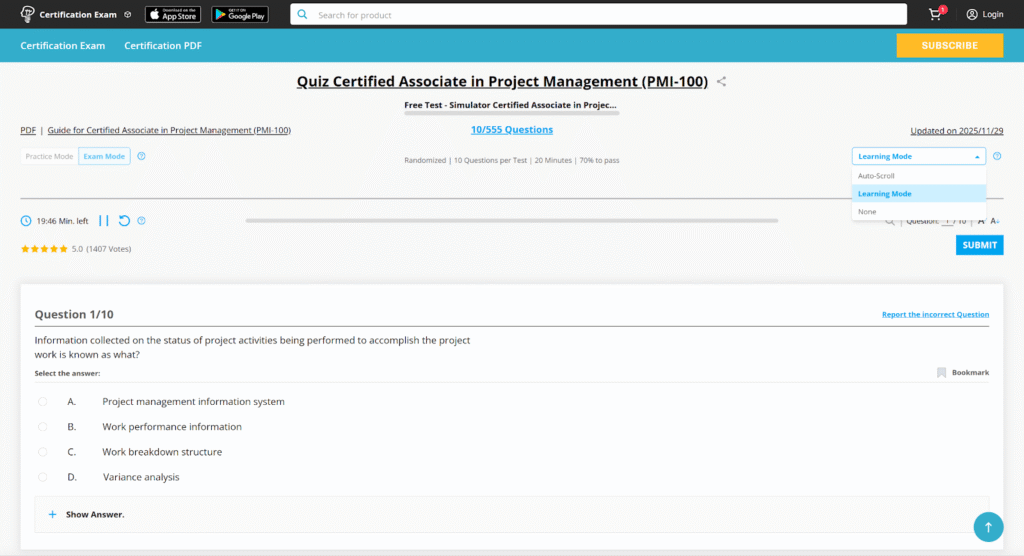
- A huge pool of questions (we’re talking over five hundred here) so you don’t get stuck just memorizing answers.
- The option to take quizzes by subject or in full exam mode. It can make a big difference in how realistic the experience feels.
Importance of Detailed Answer Explanations
Let’s be honest, this is where the real learning happens. You need to be able to get detailed explanations of every question whether you got it right or not. And I don’t just mean that you should get some vague hand-wave about why the right answer is right. I mean that you need a clear explanation, backed up with source material (think PMBOK Guide) and a clear explanation of why the correct answer was right and the other ones were wrong.
Updated vs Outdated Practice Test Content
Always check the publication date of whatever you’re studying. Some places that offer study materials, like certification-exam for example, structure their stuff specifically to reflect the current exam format and content, which can be a real plus worth looking out for.
Conclusion: Turning Practice Into PMI Certification Success
We’ve come to the end of this, but all good things must come to an end. Getting a PMI certification (starting with the CAPM) is going to be a smart move for your future, but you do need to make that knowledge work for you on the exam. And that’s exactly what a CAPM practice test is all about not just knowing it, but being able to use it on the test.
Recap of Practice-Test-Driven Preparation
We’ve talked through getting the most out of a practice test – using it as a diagnostic, a learning tool and a way to build your skills. It’s like having a map to help you figure out where you’re going.
Confidence Building Through Structured Practice
You walk into that exam and you’re not intimidated because you’ve been through this before. The format is familiar you’ve done all this before in practice. That’s the kind of confidence that can take you to the next level.
Your Path From Preparation to Certification
So what’s next? You need to commit, put together a plan that plugs in some heavy study with lots of practice, and walk out the door feeling like you’ve got this. Believe in yourself and that material, put in the work and go for that PMI certification. You can do it.