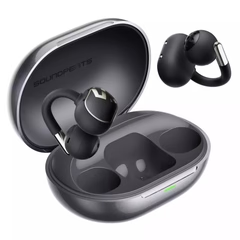
Wireless audio has changed significantly in recent years, giving listeners more choices than traditional in-ear headphones. Among the most interesting options are open ear wireless earbuds, which are designed to deliver sound without completely blocking the ear canal. This approach can provide a more comfortable and aware listening experience, making these earbuds attractive for workouts, commuting, office use, outdoor activities, and everyday entertainment.
However, choosing the right pair requires more than simply looking at appearance or price. Sound quality, comfort, battery life, connectivity, durability, controls, and fit can all affect your experience. Understanding these factors can help you select earbuds that match your lifestyle and listening habits.
Understanding Open Ear Wireless Earbuds
Open ear wireless earbuds are designed to sit near the ear rather than sealing inside the ear canal. Unlike conventional in-ear headphones, they allow some surrounding sounds to remain audible while you listen to music, podcasts, calls, or other content.
This design can be especially useful when awareness of your environment matters. For example, someone walking outdoors may want to hear traffic, cyclists, conversations, or other environmental sounds while still enjoying audio.
Open ear models are available in different designs, including ear-hook, over-ear, and clip-style configurations. Each design offers different advantages in terms of stability, comfort, and appearance.
Why Choose an Open Ear Design?
One of the biggest advantages of an open ear design is environmental awareness. Because the ear canal is not completely sealed, outside sounds can remain easier to hear. This can make the format appealing for outdoor exercise, travel, work environments, and casual listening.
Comfort is another important consideration. Some people dislike the pressure or plugged-up feeling associated with traditional in-ear headphones. Open designs can reduce that sensation because they do not require silicone tips to sit deep inside the ear canal.
They can also be practical for people who frequently move between listening and conversation. Instead of removing an earbud every time someone speaks, users can often hear the person naturally while their audio continues playing.
Consider the Fit and Wearing Style
Fit should be one of your highest priorities. Even excellent-sounding earbuds can become frustrating if they move around, create pressure, or feel uncomfortable after extended use.
When comparing models, consider how they attach to your ears. Ear-hook designs generally provide additional stability during exercise, while lightweight clip-on configurations may offer a secure fit without a large structure around the ear.
Clip on earbuds are particularly worth considering if you want a design that attaches around the outer portion of the ear. Their compact structure can provide stability while maintaining the open-ear concept.
If possible, pay attention to the materials used around the contact points. Soft-touch materials and smooth surfaces can make a substantial difference during long listening sessions.
Evaluate Sound Quality
Open ear headphones have a different acoustic challenge than sealed in-ear models. Since sound is delivered without creating a tight seal, bass performance and overall audio isolation can vary between products.
Look for a model that provides balanced audio rather than focusing exclusively on maximum volume. Clear vocals, controlled bass, detailed mids, and smooth high frequencies are valuable for music, podcasts, videos, and calls.
Audio performance can also depend on how the earbuds sit on your ears. A model that sounds impressive on one person may perform differently if its speakers are positioned farther away from the ear.
For outdoor use, remember that environmental noise can compete with your audio. An open design is intentionally less isolating, so it is important to choose a model that provides sufficient clarity without requiring uncomfortable volume levels.
Check Bluetooth Connectivity
Reliable wireless connectivity is essential for a good listening experience. Most modern wireless earbuds use Bluetooth, but specifications can differ considerably.
Check the Bluetooth version and compatibility with your smartphone, tablet, laptop, or other devices. Newer Bluetooth standards can offer improvements in efficiency, connection stability, and supported features, although real-world performance depends on both the earbuds and the connected device.
Multipoint connectivity can also be useful. This feature allows compatible earbuds to remain connected to two devices, making it easier to switch between a computer and smartphone.
Look at Battery Life
Battery life becomes particularly important if you use earbuds throughout the day. Consider both the playback time of the earbuds and the additional power available through their charging case, if one is included.
Think about your typical usage. Someone who listens for an hour during daily exercise may not need the same battery capacity as someone who uses earbuds throughout a workday.
Fast charging can also be valuable. A short charging period that provides several hours of additional listening can be convenient when you forget to recharge overnight.
Consider Call Quality
Earbuds are no longer used only for music. Many people rely on them for video meetings, phone calls, online classes, and voice communication.
If calls are important, look for models with quality microphones and noise-processing technology. Multiple microphones can help the earbuds capture your voice more clearly, while software-based processing may reduce certain types of background noise.
Keep in mind that open ear designs cannot eliminate every environmental sound. Their strength is often maintaining awareness, so the best model should balance voice clarity with the ability to remain aware of your surroundings.
Examine Controls and Smart Features
Convenient controls can make everyday use much easier. Touch controls, physical buttons, or gesture-based systems may allow you to adjust volume, pause music, skip tracks, answer calls, or activate a voice assistant.
Think about where you will use the earbuds. Physical buttons can sometimes be easier to operate while exercising, whereas touch controls may provide a cleaner design.
Companion smartphone apps can also add useful functionality. Depending on the model, an app may provide equalizer settings, firmware updates, battery information, control customization, or device-location features.
Check Water and Sweat Resistance
If you plan to use open ear wireless earbuds during workouts, water and sweat resistance should be part of your evaluation.
Look for an appropriate IP rating and understand what that rating actually protects against. Sweat resistance may be sufficient for gym sessions, while outdoor users may want stronger protection against rain and moisture.
Water resistance does not automatically mean that earbuds are suitable for swimming. Always follow the manufacturer’s usage recommendations.
Think About Your Main Use Case
The best earbuds for one person may not be the best choice for another. Start by identifying how you expect to use them most frequently.
For running and cycling, stability, lightweight construction, environmental awareness, sweat resistance, and battery life may be the most important features.
For office use, comfort, microphone quality, multipoint connectivity, and discreet styling may matter more.
For travel, battery life, charging convenience, stable connectivity, and comfortable long-term wear could become the priorities.
For casual entertainment, sound quality, comfort, controls, and overall value may be more important than advanced fitness features.
Compare Features With the Price
A higher price does not always guarantee a better listening experience. Instead of purchasing based solely on brand reputation, compare the features that matter to you.
Create a short list of essential requirements and separate them from features that are simply nice to have. For example, reliable connectivity and comfortable fit may be essential, while wireless charging may be optional.
This approach helps prevent you from paying extra for specifications you are unlikely to use.
Pay Attention to Build Quality
Durability is another factor that should not be overlooked. Examine the construction, hinges, charging case, ear-contact materials, and overall finish.
A well-designed pair should feel sturdy without becoming unnecessarily heavy. The charging case should also protect the earbuds and provide convenient portability.
If you frequently travel or exercise with your earbuds, compact construction and durable materials can become especially valuable.
Final Thoughts
Choosing the right open ear wireless earbuds is ultimately about finding a balance between comfort, audio performance, connectivity, durability, battery life, and practical features. The open design can be an excellent choice for people who want to enjoy audio while maintaining greater awareness of their surroundings.
Start with the way you intend to use your earbuds, then evaluate fit, sound quality, battery performance, microphone quality, wireless connectivity, water resistance, and controls. Designs such as clip on earbuds can be particularly appealing when stability and a lightweight wearing experience are priorities.
Rather than selecting a product based only on its appearance or price, consider how well its features match your daily routine. With the right combination of comfort, performance, and functionality, open ear wireless earbuds can become a versatile part of your everyday audio setup.